




High molecular weight borated succinimide: how to improve engine oil soot dispersancy and control sludge formation?
2026-11-05
During engine operation, soot, oil oxidation products and other insoluble contaminants formed during fuel combustion gradually enter the engine oil. If these particles cannot be stably suspended in the oil, they tend to aggregate, resulting in sludge and deposits. This can impair oil fluidity and increase the load on the cleaning system for internal engine parts.
Therefore, dispersants are one of the key functional components of modern motor oils. Poly isobutenyl succinimide (PIBSI) is a typical ashless dispersant that helps retain soot, sludge precursors and other insoluble contaminants in the oil, reducing the likelihood of particle aggregation and deposit formation. High molecular weightborated succinimidedue to its molecular structure and boron modification, it provides additional opportunities for the development of high-performance lubricant compositions.
1. Why does motor oil need an ashless dispersant?
During long-term engine operation, soot, oxidation products and other insoluble contaminants constantly accumulate in the oil. If these substances gradually aggregate, sludge, varnish deposits and other contaminants may form.
This problem is especially acute for diesel engines, in which soot formed during fuel combustion can get into the engine oil. As soot concentration increases, insufficient dispersing ability can lead to particle aggregation, increased oil viscosity and deterioration of its circulation and lubrication properties.
The main function of an ashless dispersant is to maintain insoluble particles in a stable dispersed state, reduce their tendency to aggregate and limit the formation of sludge and deposits.
Unlike metal-containing detergent additives, traditional ashless dispersants do not use metal compounds such as calcium and magnesium to provide dispersing action. Therefore, when developing motor oil formulations, they can be used in conjunction with metal-containing detergent additives to achieve a balance between detergent and dispersant properties.
2. Dispersion mechanism of polyisobutenylsuccinimide
Poly isobutenyl succinimide (PIBSI) is one of the common types of ashless dispersants used in motor oils. Its molecular structure typically includes a nonpolar polyisobutylene chain and a polar succinimide group.
These two structural components perform different but complementary functions.
Non-polar polyisobutylene chain
The polyisobutylene chain has good oil solubility, allowing the dispersant to remain stable in oil environments. In addition, through spatial screening and other mechanisms, it helps reduce the likelihood of aggregation of polluting particles.
Polar succinimide group
The polar group is capable of interacting with the surface of soot and other polar pollutants. It promotes the adsorption of the dispersant on the surface of the particles and helps maintain their stable distribution in the oil.
Thanks to this design, PIBSI helps control the aggregation of soot and sludge precursors, reducing the risk of deposit formation.
3. What features does a high molecular weight borated dispersant have?
The different types of PIBSI differ in polyisobutylene molecular weight, nitrogen content, viscosity and method of chemical modification. These parameters influence the dispersing properties of the product and its suitability for specific formulations.
High molecular weightborated succinimideis a type of dispersant obtained by boron modification of the traditional PIBSI structure. Its main features include:
High molecular structure
The high molecular weight of the polyisobutylene chain affects the spatial screening and stabilization of particles in the oil, helping to reduce their aggregation. Such dispersants are of interest in the development of motor oils for diesel engines operating under conditions of increased soot load.
Boron modification
Boron modification changes the chemical composition and functional characteristics of the dispersant. Depending on the specific molecular structure, borated dispersants can also affect anti-oxidation and anti-wear properties, as well as compatibility with sealing materials. The specific effect must be confirmed by testing as part of the finished formulation.
Increased viscosity and nitrogen content
Viscosity and nitrogen content are important technical parameters of PIBSI. Increased viscosity is usually related to the molecular structure and composition of the product, while nitrogen content is one indicator of the level of functional components containing succinimide groups.
Please note that high molecular weight, increased viscosity or high nitrogen content do not guarantee improved dispersant properties in any formulation. Actual performance also depends on molecular structure, dosage, base oil properties and compatibility with other additives.
4. Application areas of high molecular weight borated dispersant T161B
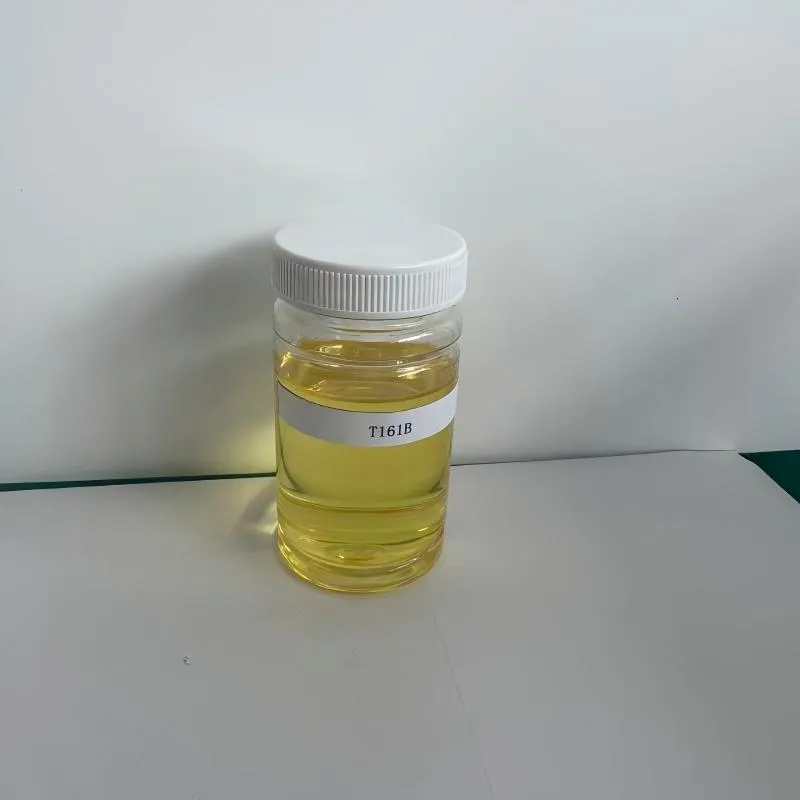
T161B is a borated high molecular weight polyisobutenyl succinimide marketed as a high viscosity, high nitrogen content dispersant.
For lubricant additive manufacturers, this product can be used as a component of an ashless dispersant system when developing motor oils and additive packages.
The main areas of its application are related to the following tasks:
Motor oils for diesel engines:helps to disperse soot formed during fuel combustion and reduce the aggregation of its particles.
Motor oils for engines operating under high loads:Helps optimize the dispersant system based on engine operating conditions and reduce the risk of sludge and deposit formation.
High performance lubricants:used in conjunction with detergents, antioxidants and other functional additives to optimize the characteristics of the finished formulation.
Development of additive packages:allows you to adjust the combination of dispersant with other components in accordance with the requirements for the target lubricant.
When developing motor oils for diesel engines with a high soot load, specialists also need to pay special attention to the effect of the dispersant on the growth of oil viscosity, piston cleanliness and stability of properties over a long period of operation.

5. What technical indicators should I pay attention to when purchasing PIBSI dispersant?
For lubricant manufacturers and purchasing professionals, selecting PIBSI based on product name alone is not enough. Regular, borated and high molecular weight varieties can differ significantly in chemical structure and technical characteristics.
When choosing a product, it is recommended to pay attention to the following indicators:
| Technical indicator | What to look for when purchasing |
| Nitrogen content | Allows you to assess the level of functional components containing nitrogen |
| Boron content | Characterizes the composition and features of the borated modification |
| Kinematic viscosity | Helps evaluate product flowability and suitability for formulation processes |
| Total Base Number (TBN) | Allows you to evaluate the alkaline characteristics of the product |
| Molecular weight and structure of PIB | Helps identify molecular structure features and potential dispersant properties |
| Flash point | Used to evaluate the basic physical characteristics of a product |
| Water content | Allows you to control the quality of the product and its stability during storage |
| Compatibility | It is necessary to check compatibility with detergents, antioxidants and other additives |
In addition, before making a large purchase, it is recommended to request a technical data sheet (TDS) and a safety data sheet (SDS) from the supplier, as well as conduct laboratory tests taking into account the requirements for the target engine oil formulation.
6. How to select the appropriate PIBSI dispersant for your engine oil formulation?
Different types of motor oils have different requirements for dispersant properties, viscosity control, deposit control and formulation stability. Therefore, the selection of PIBSI must be based on a comprehensive assessment of the base oil type, engine operating conditions, soot load and finished product performance requirements.
For standard motor oil formulations, the appropriate polyisobutenyl succinimide can be selected based on basic dispersion requirements. If we are talking about compositions operating under conditions of high soot load and placing increased demands on dispersing properties, it is advisable to additionally evaluate high-molecular-weight PIBSI and products with boron modification.
T161B borated high molecular weight polyisobutenyl succinimide (high viscosity, high nitrogen content) is an option for lubricant manufacturers developing high performance dispersant systems.
Our company specializes in the development and production of additives for lubricants and offers lubricating oil manufacturers various types of dispersants, as well as relevant technical documentation.
If you are looking for PIBSI High Molecular Weight Borated Dispersant, please contact us for T161B technical specifications, product specification and supply quotation.